

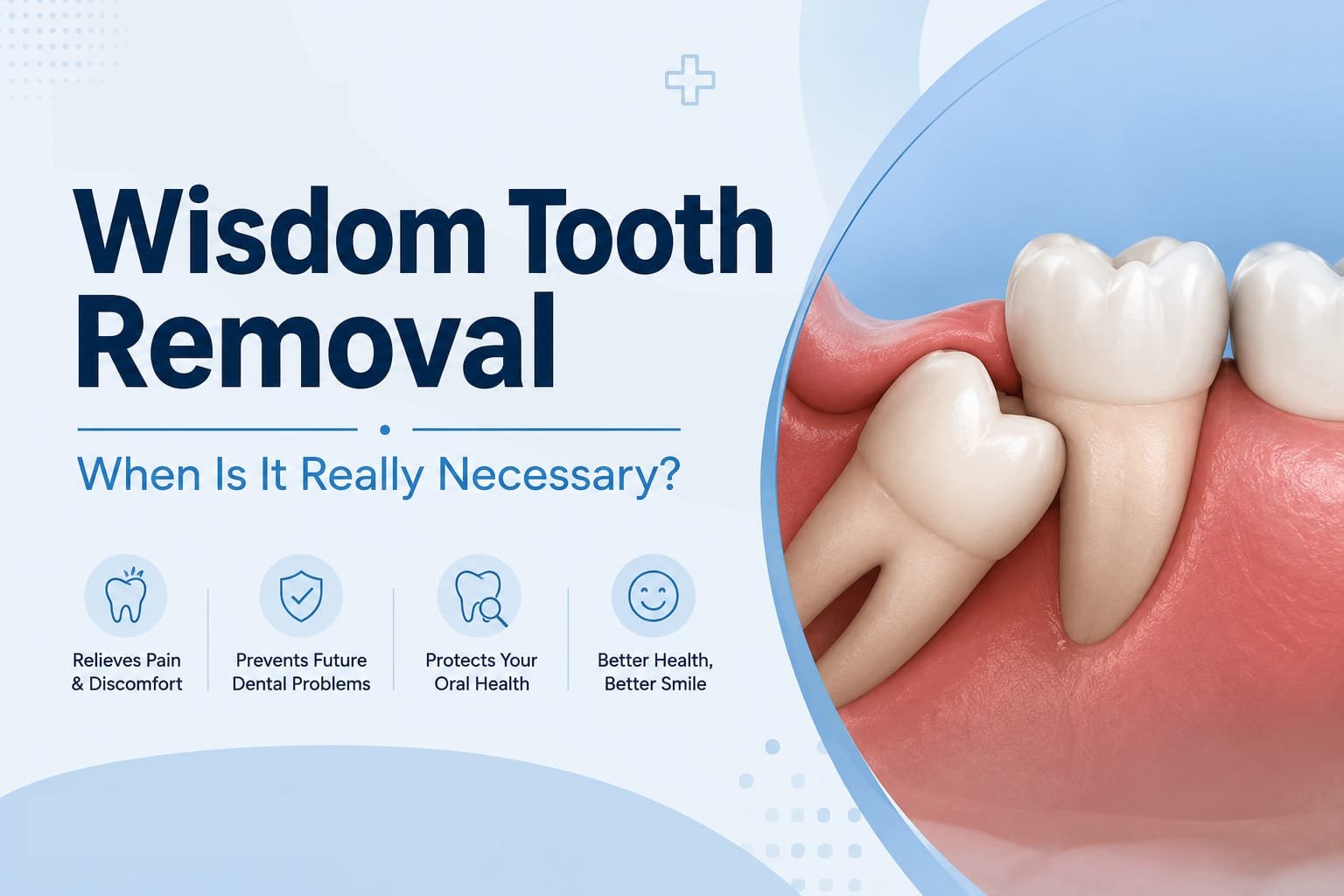
You’d think Wisdom Tooth Removal would be an easy decision. Tooth hurts, remove it. Tooth doesn’t hurt, leave it alone. If only mouths were that predictable. Some of the most difficult wisdom teeth I’ve seen never caused pain until the day they suddenly did.
Pain isn’t always the first warning.
Most wisdom teeth don’t follow the same script
Not every wisdom tooth arrives quietly. Some come in perfectly straight and become just another chewing tooth. Others stop halfway, lean against the neighboring molar, or stay buried inside the jaw for years without making a sound. That’s why When to Remove Wisdom Teeth isn’t answered by age alone.
One thing surprises patients all the time.
A wisdom tooth can look calm in the mirror while quietly damaging the tooth beside it. Food gets trapped where even a careful toothbrush struggles to reach. Over months, sometimes years, decay begins between the two teeth. By the time the pain appears, the neighboring tooth often needs more treatment than the wisdom tooth itself.
I’ve had patients come in convinced the “good” second molar was hurting. The X-ray told a different story.
Picture this: you only notice it while eating ice cream
Cold sensitivity. A dull ache while chewing. Maybe your jaw feels tight for two days and then everything settles down again. Many people assume the problem has disappeared.
It usually hasn’t.
An Impacted Wisdom Tooth often causes symptoms that come and go. That’s because the gum around a partially erupted tooth can become inflamed, calm down, and flare up again. Dentists call this pericoronitis, but patients usually describe it as “that annoying swelling behind my last tooth.”
Oddly enough, the swelling often feels worse in the morning.
Partly erupted wisdom teeth create tiny pockets where bacteria like to stay. Warmth, limited cleaning access, and trapped food make that area surprisingly stubborn to keep clean. Mouthwash helps a little, but it rarely fixes the reason the infection keeps returning.
Repeated infections usually tell us something.
Wisdom Tooth Removal isn’t always urgent
Here’s the part that sometimes disappoints people expecting a dramatic answer: not every wisdom tooth needs to come out.
Healthy wisdom teeth do exist.
If the tooth has fully erupted, can be cleaned properly, has enough space, bites normally, and shows no signs of decay, infection, or damage on an X-ray, many dentists simply monitor it during routine check-ups. Regular reviews can be a perfectly reasonable plan.
This is where opinions differ a bit.
Some oral surgeons recommend removing symptom-free wisdom teeth before problems develop because surgery is generally easier in younger adults. Others prefer avoiding surgery unless there’s a clear reason. Both viewpoints have supporting evidence, which is why your X-rays, age, medical history, and symptoms matter more than a blanket rule.
No single answer fits everyone.
What actually changes the decision?
Several things.
A tooth pressing against the second molar. Repeated gum infections. A cavity that can’t be restored properly. A cyst forming around the tooth. Persistent jaw pain linked directly to the wisdom tooth. These situations often make Wisdom Tooth Extraction the better long-term option.
People often ask about Wisdom Tooth Pain Treatment first, hoping antibiotics or painkillers will solve everything.
Sometimes they do—for a while.
Medication reduces infection and controls discomfort, but it doesn’t change the position of an impacted tooth. Think of it as calming a smoke alarm without putting out the small fire causing it. Once the medicine wears off, the same problem may return.
The hardest part isn’t usually the extraction.
It’s deciding whether today’s small inconvenience prevents a much bigger one a year later. That’s a conversation worth having with someone who has seen your X-rays rather than someone sharing horror stories online.
Frequently Asked Questions
Does every impacted wisdom tooth need removal?
No. Some impacted teeth remain stable for years without causing damage. Regular dental examinations and X-rays help determine whether monitoring or treatment is the safer choice.
Is Wisdom Tooth Removal Painful?
The procedure itself is usually done under local anesthesia, so you shouldn’t feel pain during treatment. Some soreness and swelling afterward are expected and generally improve over several days.
At what age is it best to remove wisdom teeth?
Many extractions are performed between 17 and 25 because healing is often quicker. Still, age alone doesn’t decide treatment. The condition of the tooth matters more.
Can wisdom tooth pain disappear on its own?
Yes, temporarily. The pain may settle as inflammation reduces, but the underlying issue can remain. If discomfort keeps returning, it’s worth getting the tooth examined.
The question was never really whether a wisdom tooth exists. Most adults have one or more. The better question is whether that tooth is quietly fitting into your mouth—or quietly creating tomorrow’s problem.
If you’re unsure, an examination and a simple dental X-ray usually answer more questions than weeks of guessing. At Omlesh’s Dentcity, Rohini, we believe patients make better decisions when they understand why treatment is recommended, not just what treatment is suggested.
