

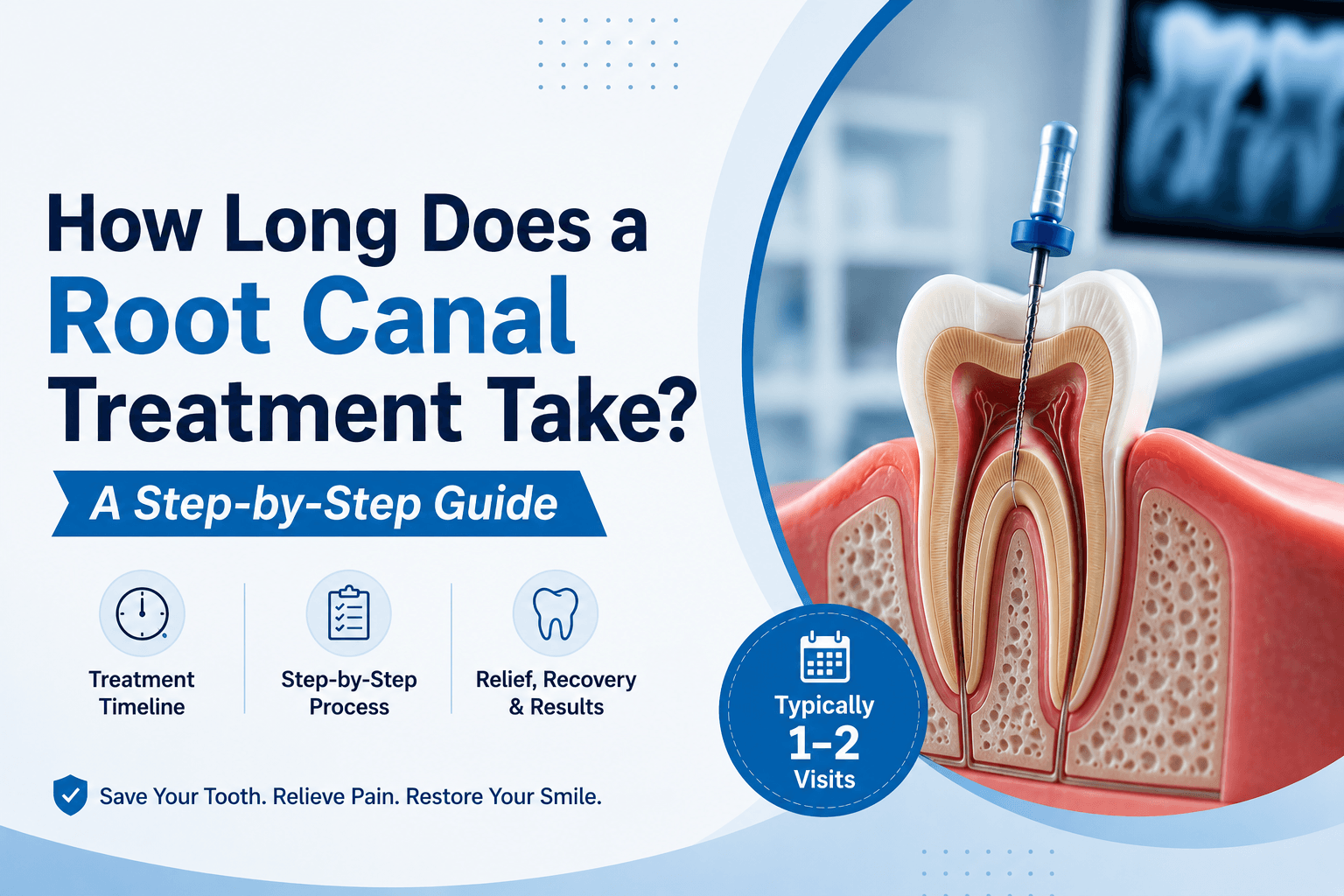
A lot of people ask the same question before booking an appointment: “How long will I be sitting in the dental chair?” Fair question. The words Root Canal Treatment already make many people imagine a long, uncomfortable procedure, when in reality it’s often much simpler than they expected. The answer isn’t the same for everyone because every tooth tells a slightly different story.
Some root canals take less than an hour. Others need two visits. It depends on what your tooth has been through before you arrived.
Why one patient’s appointment is 45 minutes and another’s is two hours
Here’s something patients rarely expect. Two people can walk into the clinic with the same complaint—”my tooth hurts”—and leave after completely different treatment times.
A front tooth usually has one canal. A molar at the back can have three or four, and sometimes those canals curve in ways that don’t show up until treatment begins. That’s why giving an exact timeline over the phone isn’t always possible.
I’ve also noticed something else over the years. The tooth that barely hurts sometimes turns out to be more infected than the one causing sleepless nights.
Pain isn’t a stopwatch.
If the infection is straightforward, a Root Canal Treatment may take around 45 to 60 minutes. Molars generally need 60 to 90 minutes, and teeth with complicated anatomy or previous dental work may require a second appointment.
The goal isn’t to finish quickly.
The goal is to clean every infected canal properly because bacteria left behind don’t care how fast the appointment was.
What actually happens during Root Canal Treatment?
Most people imagine the drill. That’s usually the smallest part of the visit.
The first few minutes are spent making sure you’re comfortable. Local anesthesia numbs the tooth so the treatment can begin without pain. Modern Painless Root Canal Treatment techniques have changed the experience for many patients who expected something much worse.
Then the dentist places a rubber sheet around the tooth. It looks unusual if you’ve never seen one before, but it keeps the area dry and prevents bacteria from saliva entering the tooth.
A clean workspace matters.
Next comes the careful part.
Tiny instruments remove infected pulp tissue from inside the canals. The canals are measured, cleaned, disinfected, and shaped before they’re sealed with a filling material designed specifically for root canals.
One thing that surprises patients is how small everything is. The inside of a tooth isn’t a large hollow space. Some canals are thinner than the tip of a sewing needle.
That’s where experience matters.
Many clinics now use digital X-rays and magnification to locate hidden canals that might otherwise be missed.
Sometimes the tooth isn’t ready to be sealed on the same day
This catches people off guard.
If there’s significant swelling, persistent infection, or drainage from the tooth, your dentist may clean the canals, place medication inside, and seal the tooth temporarily before completing the Endodontic Treatment at the next visit.
That extra appointment isn’t bad news.
Quite the opposite.
It’s often the safer option because sealing bacteria inside a tooth before the infection settles can reduce the chances of long-term success.
Years ago, many dentists routinely performed root canals over multiple visits. Today, better instruments and improved cleaning solutions mean many teeth can be treated in a single appointment, but not every tooth follows the textbook.
Does a Root Canal Treatment hurt during or after the procedure?
The reputation of root canals has survived much longer than the pain usually does.
Most patients tell us afterward that the procedure felt surprisingly similar to getting a dental filling. The discomfort they feared was actually coming from the infection before treatment—not from the treatment itself.
That’s an interesting difference.
Once the infected nerve tissue has been removed, many patients feel relief rather than increased pain.
Some tenderness while biting is normal for a few days because the tissues around the root have been inflamed. Your dentist may recommend pain medication if needed, but severe pain isn’t what most people experience after modern Painless Root Canal Treatment.
One small observation I’ve made over the years: patients often spend more time worrying in the waiting room than they do feeling uncomfortable in the dental chair.
Anxiety usually lasts longer than the procedure.
What happens after the root canal is finished?
Cleaning the canals isn’t always the final step.
A tooth that has needed Infected Tooth Treatment has often lost a fair amount of its natural strength. Back teeth, especially molars, usually benefit from a dental crown because they handle the highest chewing forces every day.
Think of it this way.
The root canal saves the tooth from infection. The crown helps protect it from cracking later.
Not every tooth needs a crown immediately, but delaying the final restoration for months isn’t something I’d recommend. Temporary fillings aren’t designed for long-term chewing, and bacteria can find surprisingly small gaps if they’re given enough time.
The treatment isn’t really complete until the tooth is fully restored.
People often ask how long a Root Canal Treatment takes, but I think a better question is this: How long do you want to keep your natural tooth?
An extra thirty minutes in the dental chair can save years of chewing comfortably with your own tooth. That’s a trade most patients are happy to make once they understand what’s actually happening.
If you’ve been advised to have a root canal and still have questions, the team at Omlesh’s Dentcity in Rohini, New Delhi is always happy to explain the process before treatment begins. Understanding what’s ahead usually removes half the fear.
Frequently Asked Questions
How long does a Root Canal Treatment usually take?
Most treatments take between 45 and 90 minutes. Complex molars or severely infected teeth may require a second appointment.
Can a root canal be completed in one visit?
Yes. Many teeth can be treated in one visit. If there’s extensive infection or swelling, your dentist may recommend two visits for better healing.
Is Root Canal Treatment painful?
Modern Painless Root Canal Treatment is performed under local anesthesia. Most patients report feeling pressure rather than pain during the procedure.
Why do some root canals need two appointments?
A second visit may be needed if the tooth has a severe infection, multiple canals, or requires medication inside the tooth before permanent sealing.
