

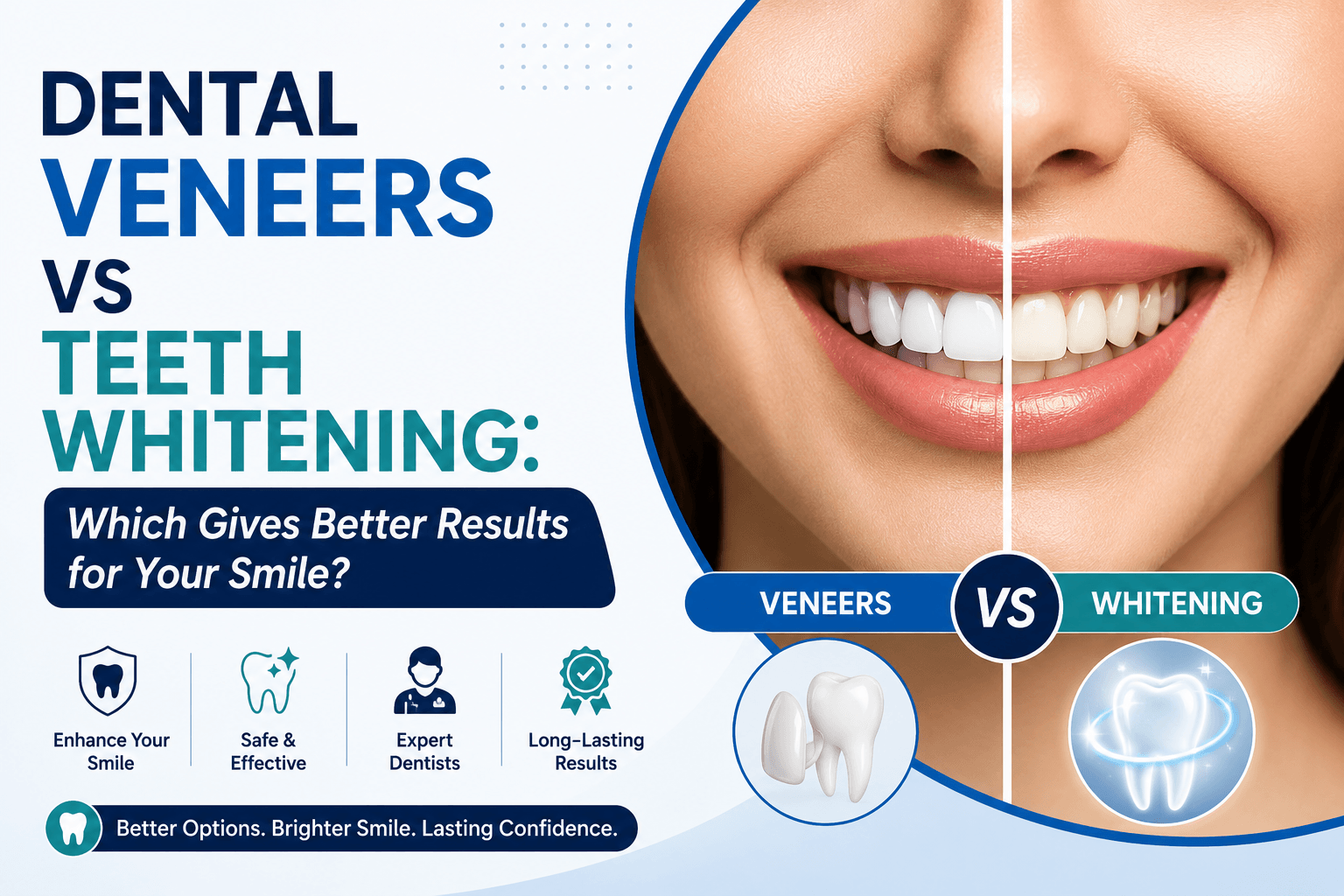
A funny thing happens in consultations. Someone points at a celebrity’s smile and says, “Can whitening make my teeth look like that?” Most of the time, the answer starts with another question. That’s because Dental Veneers vs Teeth Whitening isn’t really a competition. They’re designed to solve different problems, even though both can leave you smiling more than you did before.
People often think they’re choosing between two versions of the same treatment.
They aren’t.
Dental Veneers vs Teeth Whitening: It depends on what you’re trying to change
The color of your teeth is only one part of your smile. Shape, size, spacing, tiny chips, worn edges—even the way light reflects from the enamel—change how your smile looks. That’s where people sometimes expect whitening to perform magic it simply can’t.
Imagine painting a scratched wall.
The color may improve, but the dents are still there.
Teeth Whitening removes or lightens stains within natural tooth enamel. Coffee, tea, wine, tobacco, and simply getting older can darken teeth over time. Whitening can brighten healthy teeth remarkably well, but it won’t repair cracks, reshape uneven edges, or hide fillings that have changed color.
Dental Veneers, on the other hand, cover the front surface of the teeth. They’re thin porcelain or composite shells that change both color and appearance. If someone has uneven teeth, stubborn discoloration from childhood medications, small gaps, or chipped corners, veneers often solve several concerns at once.
One detail surprises patients every week.
Sometimes the tooth that bothers them most isn’t the one anyone else notices.
What whitening does really well—and where it quietly stops
Here’s something I wish more people knew before buying whitening kits online.
Natural enamel doesn’t whiten evenly forever.
Teeth respond differently depending on the type of stain. Yellow teeth often lighten better than grey or brown discoloration. Internal stains caused by trauma or certain medications can barely change at all, no matter how many whitening sessions someone tries.
That’s frustrating.
Professional Teeth Whitening is safer and generally more predictable than over-the-counter products because the bleaching gels are stronger and monitored carefully. But even then, dentists can’t promise a specific shade.
Biology gets a vote.
One odd thing I’ve noticed is that patients often stare at the mirror immediately after whitening under bright clinic lights. Walk outside into natural daylight and the result suddenly looks completely different. Light changes perception more than people expect.
If your teeth are healthy and you simply want them brighter, whitening is usually the more conservative choice because it preserves the natural tooth structure.
Picture someone hiding their smile in every photograph
That’s the patient who often benefits from Dental Veneers.
Color is only half the story.
Veneers don’t bleach teeth; they redesign what people see. A slightly twisted tooth, a chipped front edge, worn enamel from years of grinding, or spaces that collect everyone’s attention can often be corrected without orthodontics in selected cases.
The word “perfect” gets thrown around too easily.
The best veneers don’t look perfect.
They look believable.
Natural teeth have tiny variations in translucency, texture, and reflection. Good veneers copy those details instead of creating an unnaturally bright row of identical white rectangles. Ironically, the smiles that attract compliments usually aren’t the whitest ones. They’re the ones that look like they belonged there all along.
That’s easy to miss.
Veneers do require removing a small amount of enamel in many cases, although minimal-preparation techniques may be possible for some patients. That’s why they’re usually considered after discussing all available options instead of being everyone’s first answer.
Teeth Whitening vs Veneers isn’t about which treatment is better
It’s about which problem you’re solving.
Patients sometimes arrive convinced they need veneers because they’ve seen dramatic smile makeovers online. After an examination, whitening alone gives them exactly what they wanted.
The opposite happens too.
Someone spends months whitening teeth that remain patchy because the discoloration sits inside the tooth rather than on it. No whitening gel can change the structure underneath healthy enamel.
Treatment plans aren’t fashion trends.
They should match the person sitting in the chair.
Another detail worth mentioning is maintenance. Whitened teeth can gradually darken again if coffee, tea, smoking, or colored foods remain part of daily life. Veneers resist staining better, but the surrounding natural teeth still age and change color. Occasionally, patients with veneers choose whitening later—not for the veneers themselves, but for the neighboring teeth.
That’s a conversation many people never expect.
The smile you’re chasing may already be closer than you think
People often believe they need a dramatic cosmetic procedure because they’re used to seeing filtered smiles on phones every day. Real teeth aren’t perfectly symmetrical. Tiny imperfections are surprisingly human.
Sometimes that’s the nicest part.
I’ve seen patients spend twenty minutes debating the shade of veneers and then laugh without thinking about their teeth for the first time in years. That’s usually the moment I remember—not the shade guide.
If you’re deciding between Dental Veneers vs Teeth Whitening, don’t begin with the treatment. Begin with the reason you avoid smiling. Once that’s clear, the choice often becomes much easier.
If you’d like honest advice about which option fits your smile rather than what’s trending online, the team at Omlesh’s Dentcity in Rohini Sector 8 is always happy to walk you through the possibilities without rushing the decision.
Frequently Asked Questions
Can teeth whitening give the same results as veneers?
Not always. Teeth whitening improves the color of natural teeth, while veneers can also change shape, size, minor alignment, and cover deep stains.
How long do dental veneers last?
Porcelain veneers often last 10–15 years or longer with good care. Composite veneers generally have a shorter lifespan.
Do veneers damage natural teeth?
A small amount of enamel is usually removed for traditional veneers. Your dentist will discuss whether veneers or another cosmetic treatment is the better choice.
Which is more affordable, teeth whitening or veneers?
Professional teeth whitening usually costs much less than veneers because it changes only tooth color rather than rebuilding the visible surface of the tooth.
