

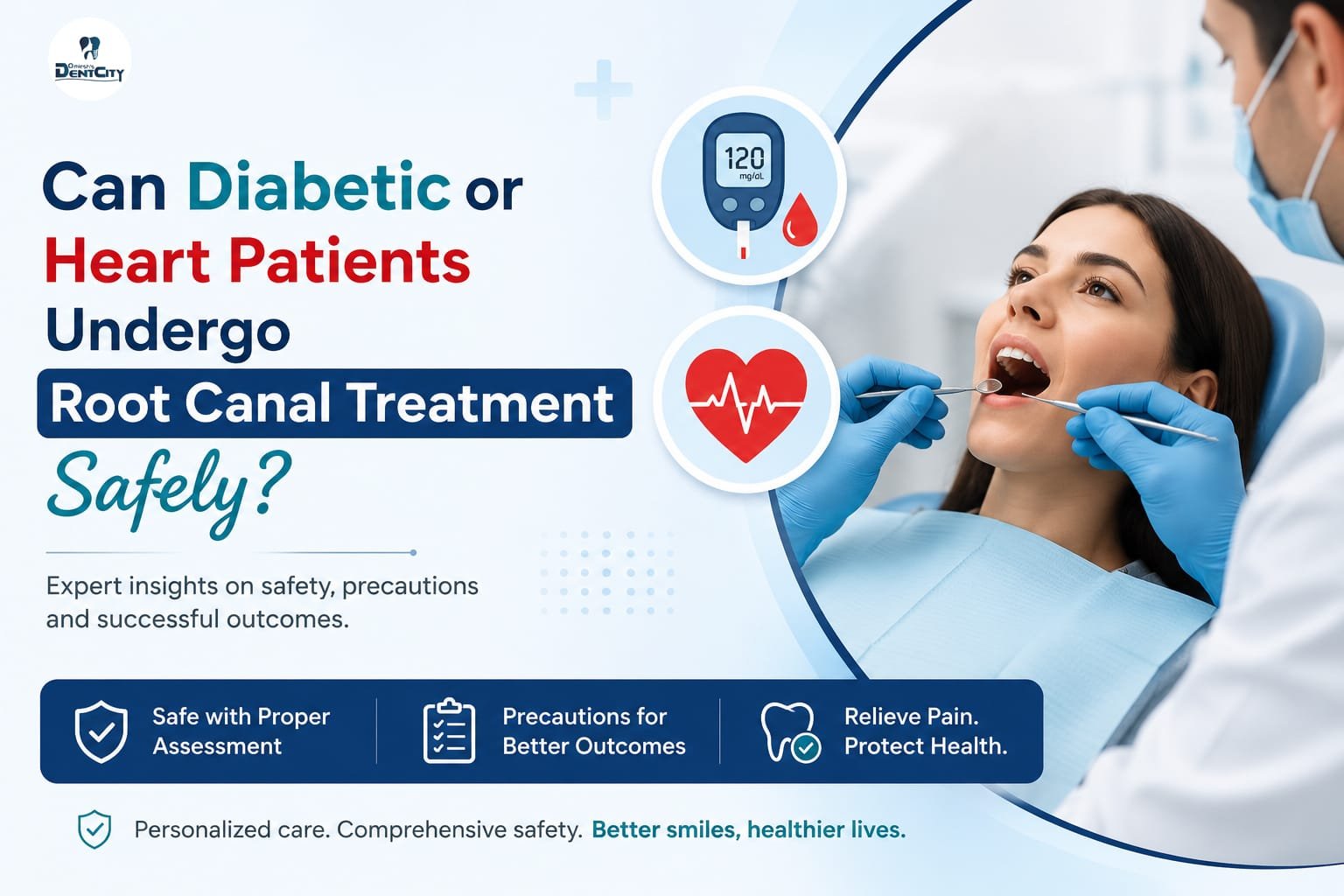
A surprising number of patients express concern about their teeth before they even sit in the dental chair.
“Doctor, I have diabetes.”
Or, “I had undergone a heart surgery few years ago.”
They say it as if it automatically disqualifies them from treatment. The truth is that Root Canal Treatment for Diabetic and Heart Patients is performed every day. The question usually isn’t whether treatment can be done. The question is whether it has been planned properly.
A tooth infection doesn’t care about your blood sugar levels or cardiac history. It just keeps spreading.
The infection is often riskier than the treatment
Many people worry about the root canal itself. Fair enough. Any dental procedure sounds intimidating when you already manage a medical condition.
But here’s the strange part.
In some cases, leaving an infected tooth untreated creates more stress on the body than treating it.
Bacteria from a dental infection can increase inflammation throughout the body. For diabetic patients, infections can make blood sugar harder to control. For heart patients, chronic infections are something doctors generally prefer not to leave sitting around for months.
I’ve seen patients spend six weeks debating treatment while chewing on one side and taking painkillers every night.
The tooth wasn’t getting better.
What most people miss is that root canal treatment is designed to remove infection while preserving the natural tooth. Once the source of infection is removed, many patients actually feel healthier than they did before treatment.
That doesn’t mean every case is identical. Medical history changes the planning.
Not the goal.
Is Root Canal Safe for Diabetic Patients?
Blood sugar control matters more than the diabetes label itself.
Two diabetic patients can walk into the same clinic and have completely different risk profiles. One may have stable glucose readings and excellent healing capacity. The other may be struggling with frequent fluctuations and recurring infections.
That’s where the conversation starts.
If blood sugar levels are reasonably controlled, root canal treatment is generally considered safe. Dentists may schedule appointments at specific times of day, review medications, and sometimes coordinate with the patient’s physician if needed.
Here’s something that surprises many people.
Some diabetic patients heal better after the infected tooth is treated because the body is no longer fighting a chronic infection.
The relationship works both ways.
Dental Treatment for Diabetic Patients often requires extra attention to healing and infection control, but diabetes alone is rarely a reason to avoid treatment.
What dentists dislike is uncertainty. Recent blood sugar reports tell a much clearer story than assumptions.
Picture this: a patient with a heart stent needs a root canal
The call usually comes before the appointment.
The patient asks whether the procedure is dangerous because they have a stent, a bypass history, or take blood thinners.
That’s a reasonable concern.
Root Canal Treatment for Heart Patients requires a careful review of medications and cardiac history. Blood thinners, for example, are often prescribed for a reason. Stopping them without medical advice can be more dangerous than continuing them.
This is where communication matters.
A dentist may consult the cardiologist, review recent reports, and decide whether any adjustments are necessary. In many situations, treatment proceeds safely with appropriate precautions.
I’ve noticed something over the years.
Patients often fear the dental procedure itself, while dentists spend more time thinking about medications, blood pressure readings, and timing.
Different worries.
Can Heart Patients Get a Root Canal? In many cases, yes. The key is making sure the dental team understands the medical background before treatment begins.
Precautions Before Root Canal Treatment are usually simple
Most patients expect a long list.
Usually it isn’t.
Bring an updated medication list. Share recent medical reports if available. Inform the dentist about insulin, blood thinners, pacemakers, stents, valve replacements, or any recent hospitalizations.
Small details matter.
One patient once forgot to mention a medication because he considered it “just a blood thinner.” That single piece of information changed how the appointment was planned.
The procedure itself stayed the same.
The preparation changed.
Precautions Before Root Canal Treatment are less about creating obstacles and more about removing surprises. Dentistry tends to work best when nobody has to guess.
And yes, eating before the appointment is often a better idea than arriving hungry and anxious—especially for diabetic patients following medication schedules.
Age changes the conversation more than people expect
A patient in their seventies once asked me whether root canals were “only for younger teeth.”
I understood what he meant.
Many older adults assume extraction is automatically the safer choice. Sometimes it is. Sometimes it isn’t.
Root Canal Treatment for Senior Citizens depends less on age and more on the condition of the tooth, bone support, medical history, and personal goals.
An eighty-year-old with stable health can be an excellent candidate.
A fifty-year-old with uncontrolled medical problems may require more planning.
That’s why age alone tells us very little.
The interesting thing is that many senior patients recover faster than they expected. They’ve already learned something younger patients haven’t: worrying about a procedure is often harder than going through it.
Frequently Asked Questions
Can diabetic patients undergo root canal treatment safely?
Yes, in most cases. Dentists usually review blood sugar control, medications, and recent medical history before treatment.
Can heart patients get a root canal while taking blood thinners?
Often yes. The dentist may coordinate with the patient’s cardiologist before making treatment decisions. Never stop prescribed medication without medical advice.
Are antibiotics always needed before a root canal?
Not always. The need for antibiotics depends on the infection, medical history, and specific heart conditions.
Is extraction safer than a root canal for medically compromised patients?
Not necessarily. In many situations, preserving the tooth through root canal treatment may be less invasive than extraction and replacement options.
A diagnosis like diabetes or heart disease changes how a dentist plans treatment. It doesn’t automatically close the door on treatment.
I’ve met patients who delayed care for months because they assumed their medical condition made dentistry unsafe. Then they finally came in, we reviewed their history, adjusted the plan, and completed the treatment without the drama they had imagined.
Sometimes the biggest obstacle isn’t the root canal.
It’s the assumption that you can’t have one.
If you have questions about Root Canal Treatment for Diabetic and Heart Patients, the team at Omlesh’s Dentcity in Rohini can review your medical history and help you understand what applies to your specific situation.
