

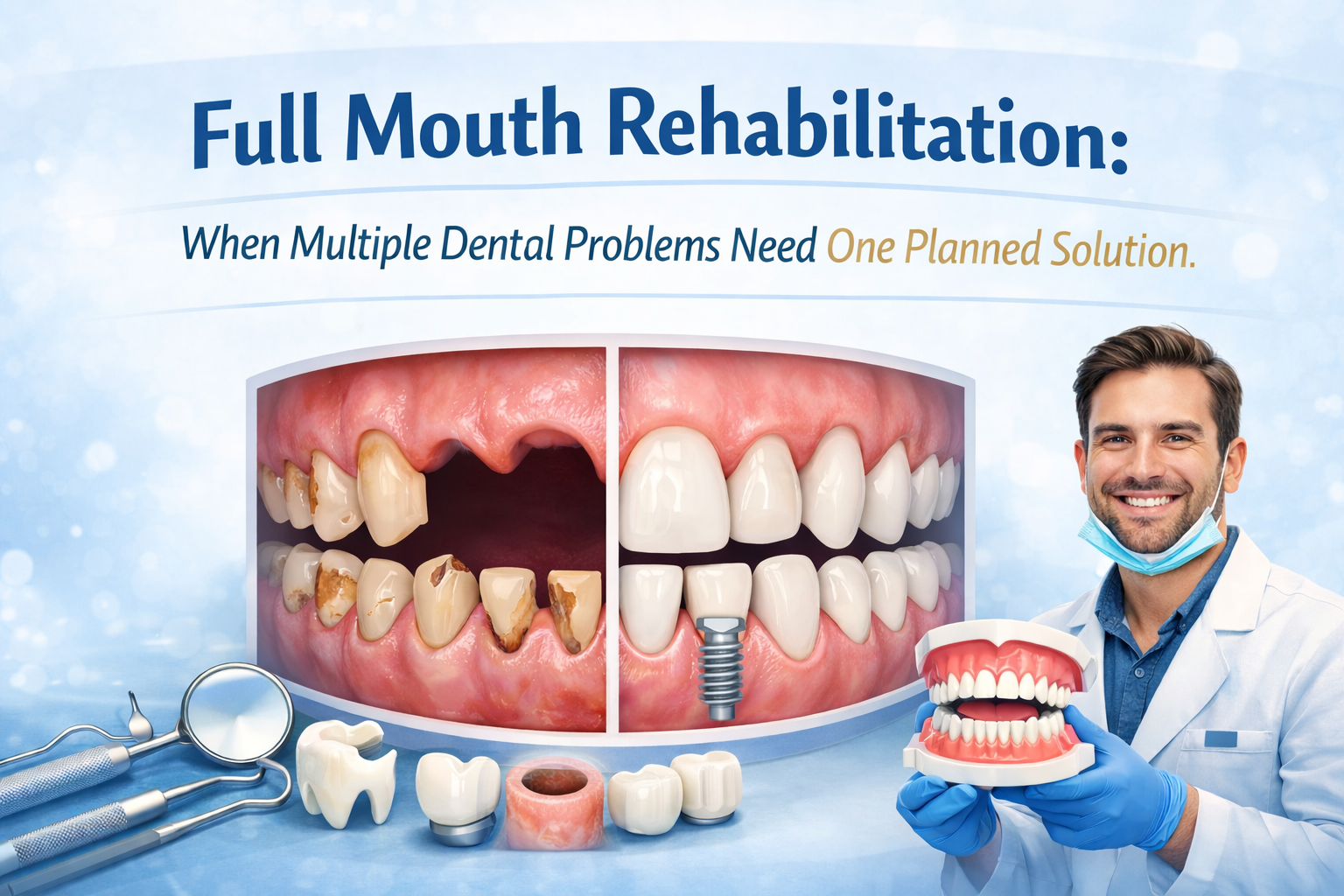
Most dental problems don’t arrive alone.
They accumulate quietly—one cracked tooth here, chronic sensitivity there, missing molars that were never replaced, and old fillings that stopped working years ago. Over time, chewing changes. Jaw muscles overwork. Confidence drops. And suddenly, fixing “just one tooth” no longer solves the real problem.
This is where full mouth rehabilitation becomes necessary—not as a cosmetic upgrade, but as a carefully planned medical solution for restoring function, comfort, and long-term oral health.
When Individual Treatments Stop Working
Dental care often begins reactively. A cavity gets filled. A toothache gets treated. A crown replaces a fracture. But when multiple issues exist at once, isolated treatments can create more imbalance than relief.
Some signs that you need full mouth rehabilitation are:
- Several teeth that are missing or very worn
- Chronic pain in the jaw or discomfort when biting
- Chewing is hard or the pressure is uneven when you chew
- Bite that has fallen apart because of worn or missing teeth
- Dental work that has failed over time
- A change in the shape of your face or the height of your smile that is easy to see
At this point, dentistry stops being about fixing each tooth and starts looking at how the whole mouth works as a system.
What Full Mouth Rehabilitation Really Means
Full mouth rehabilitation, which is also called full mouth reconstruction, is not one procedure. It is a strategic treatment plan that combines restorative, prosthetic, and sometimes surgical dentistry to rebuild the entire oral structure.
The goal is not just to improve appearance but to restore:
- Proper bite alignment
- Chewing efficiency
- Jaw joint stability
- Tooth durability
- Long-term oral balance
Each treatment is sequenced carefully so that every tooth, restoration, and muscle works together, not against each other.
Who Usually Needs Full Mouth Rehabilitation?
This type of treatment is often suggested for people who have had years of dental wear, neglect, trauma, or problems with their whole mouth.
Some common candidates are
1. People with very worn teeth or severely attrided teeth
Over time, grinding (bruxism), acid erosion, or long-term chewing stress can flatten teeth. This makes the bite height lower and puts stress on the jaw joint.
2. Patients Who Have a Lot of Missing Teeth
When teeth are lost and not replaced, the teeth around them move, the forces of biting change, and the teeth that are left get weaker faster.
3. Patients Who Have Bad Dental Work
Crowns, bridges, and fillings that were put in without a full plan often don’t work evenly, which makes your bite unstable.
4. People Who Have Problems With Their Jaw or Bite
Chronic headaches, jaw clicking, facial pain, or uneven chewing may signify bite collapse or TMJ involvement.
5. Patients Who Have Been Hurt or Have Advanced Dental Disease
Accidents, severe decay, or gum disease can damage the structure of the mouth.
The Planning Phase: The Real Start of Rehabilitation
Before any treatment begins, the most important part of full mouth rehabilitation takes place.
A proper diagnostic phase usually has:
- Thorough clinical examination
- 3D imaging and digital X-rays
- Analysis of bites and jaw movement
- Taking measurements of the face and checking the smile
- Review of past restorations and failures
This stage answers one key question:
What needs to be rebuilt first so that everything else can work?
Even good dental work can fail early if you don’t plan ahead.
Common Steps in Full Mouth Rehabilitation
Every rehabilitation plan is different, but most include some of the following treatments:
- Crowns and bridges are used to fix broken teeth and bring the bite height back to normal
- Dental implants replace missing teeth and give the bone support it needs to keep the face from collapsing further
- Veneers or onlays are used sparingly to reshape and strengthen teeth that have become worn down
- Treatments for Root Canals save teeth that are healthy on the outside but have an infection on the inside
- Periodontal Therapy treats gum disease to make sure that restorations have a strong base
- Bite Correction changes how teeth meet to ease muscle strain and stop damage from happening again
Not all patients need every procedure. The key to full mouth rehabilitation is accuracy, not too much treatment.
Why Sequencing Is More Important Than Speed
One of the worst things patients can do is hurry through treatment.
Full mouth rehabilitation follows a logical order, and it usually includes things like
- Stabilizing infections or pain
- Taking care of the gums and other supporting structures
- Finding the right bite position
- Fixing back teeth so they work again
- Finishing the front teeth for looks and balance
If you skip steps or rush into cosmetic work without making sure the function is stable, you may end up with cracked restorations, pain that keeps coming back, or a bite that doesn’t work.
Restoration of function comes before aesthetics.
What the Main Goal Really Is
The main point is:
- Evenly spread out bite force
- Jaw movement that feels good
- Restorations that last a long time
- Stopping future breakdowns
When function is restored correctly, aesthetic enhancement occurs organically rather than artificially.
Is Full Mouth Rehabilitation Painful?
Dentists today put a lot of emphasis on comfort at every step.
Most patients say that with the right planning, anesthesia, and phased treatment:
- Little pain
- Changes should happen slowly, not all at once
- Once the bite problems are fixed, the chronic pain will be much less severe
In fact, a lot of people go to rehab because they are already in pain every day, and the treatment helps.
Long-Term Benefits That Go Beyond the Smile
Full mouth rehabilitation is an investment in more than just how your mouth looks.
Some long-term benefits are:
- Better digestion because of chewing correctly
- Less pain in the jaw and face
- Less likely to lose teeth in the future
- Dental restorations that are stronger and last longer
- More self-assurance in both social and work situations
Most importantly, patients feel more stable because they know their dental health is no longer fragile.
Value and Cost Considerations
When you look at full mouth rehabilitation as a single number, it may seem expensive. But when you look at it over time, it often takes the place of years of repairs, emergency visits, and failed treatments.
A rehabilitation plan that is well thought out:
- Cuts down on future dental costs
- Makes restorations last longer
- Stops problems that could be avoided
The real cost isn’t getting treatment; it’s putting it off until the damage can’t be fixed.
Choosing the Right Dental Team Matters
Full mouth rehabilitation requires a dentist or team that is experienced in:
- Planning for complicated cases
- Occlusion and the mechanics of biting
- Long-term strategies for restoration
- Talking to and teaching patients
This isn’t normal dentistry.
It is a complete reconstruction of the mouth, and experience is important.
Final Thoughts: One Plan, Not Many Fixes
When dental problems become interconnected, isolated treatments stop working.
Full mouth rehabilitation offers something different—a single, cohesive plan designed to restore balance, function, and confidence in a structured, predictable way.
It is not about doing more dentistry.
It is about doing the right dentistry, in the right order, for lasting results.
Frequently Asked Questions
Is full mouth rehabilitation only for older patients?
No. It is based on dental condition, not age. Many younger patients need it due to wear, trauma, or bite issues.
Can treatment be done in stages?
Yes. Phased treatment is common and often recommended for comfort and financial planning.
Will I need to replace all my teeth?
Not necessarily. Healthy teeth are preserved whenever possible.
Is full mouth rehabilitation permanent?
With proper care and maintenance, results are long-lasting and often life-changing.
How do I know if I need it?
If multiple dental issues are affecting comfort, chewing, or confidence, a comprehensive evaluation is the best first step.
