

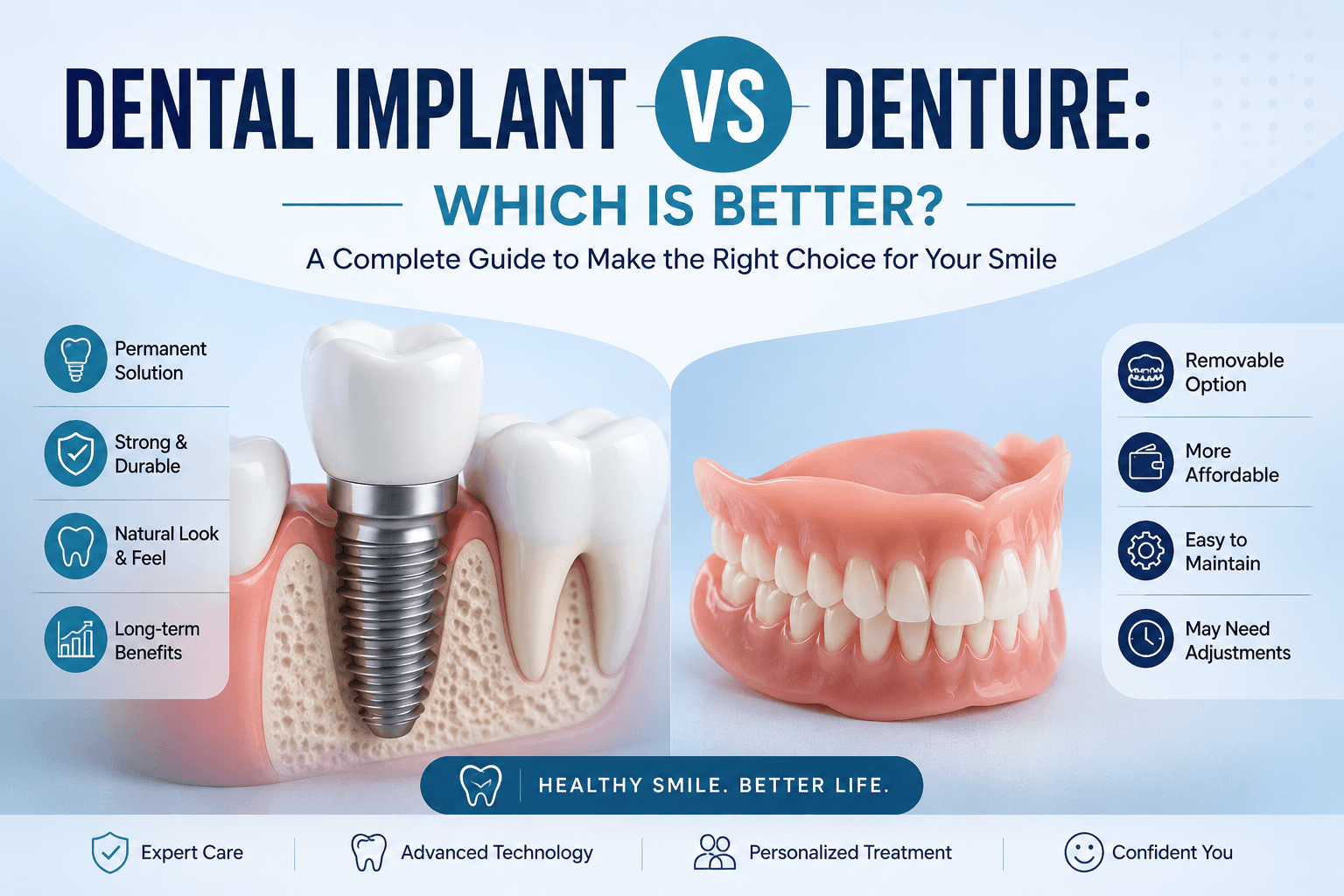
Dental Implant vs Denture: Which Is Better?
You don’t notice how much you rely on a tooth until it’s gone. Chewing shifts to one side. Speech feels slightly off. Even your jaw starts to change shape over time. That’s usually when people start comparing a Dental Implant with a denture—and the answers they find online often sound cleaner than reality.
Dental Implant: the part people don’t think about
Most patients come in thinking an implant is just a “screw with a tooth on top.” That’s not wrong. It’s also not the interesting part.
What matters is what happens after it’s placed. Over a few months, your bone grows around that titanium post and holds it in place. That process—osseointegration—is why a Dental Implant doesn’t wobble the way other replacements can.
I’ve had patients forget which tooth was the implant.
Denture: works, but asks for cooperation
A Denture does its job. It fills the gap, restores your smile, lets you eat again. For many people, it’s the first step back to normal.
But it’s not passive. It asks you to adjust.
Some patients press their tongue against it when they speak. Others learn to chew more carefully, especially with foods that stick or slide. These aren’t failures. They’re adaptations.
One small thing I’ve noticed—people with new dentures tend to laugh a little differently at first. Not less. Just… slightly guarded.
Dental Implant vs Denture: where the difference shows up
On paper, both replace teeth. In real life, they feel nothing alike.
Biting into something firm tells you everything. With a Dental Implant, the pressure goes straight into the bone, just like a natural tooth. There’s no second thought.
With a denture, there’s often a pause.
Not always obvious. Just enough that your brain checks itself before you bite harder.
A 2016 review in the Journal of Prosthetic Dentistry estimated dentures restore only a fraction of natural bite force. That’s why some foods quietly disappear from people’s diets.
Bone changes… whether you feel it or not
After a tooth is lost, the jawbone underneath starts shrinking. Slowly. Quietly. No pain, no warning.
A Dental Implant interrupts that process. Because it sits in the bone, it keeps that area active. Think of it like weight-bearing exercise for your jaw.
A denture doesn’t do that.
Over years, the bone under a denture reduces. The fit changes. That’s why dentures need relining—adjusting the inside surface so they sit properly again.
What most people miss is how this affects the face. The lower third of the face can look slightly sunken over time.
Full Mouth Rehabilitation changes the conversation
When someone is missing many teeth, the question shifts. It’s no longer about one tooth. It’s about rebuilding the entire bite—what dentists call Full Mouth Rehabilitation.
Dentures can do this. They’ve done it for decades.
But there’s another approach—Full Mouth Rehabilitation with Dental Implant support. Instead of resting on gums, a set of implants anchors a full row of teeth. Fewer implants than people expect, actually. Sometimes four to six per arch.
The first meal after that treatment tends to be memorable.
Not because it’s special food. Because it feels normal again.
So which one is better?
That depends on what you’re willing to live with.
A Dental Implant asks for surgery, healing time, and a higher upfront cost. In return, it gives stability and something close to your natural tooth.
A denture skips surgery. It’s quicker. More affordable at the start. But it asks for small adjustments every day—some people don’t mind that. Others do.
Neither choice is wrong.
But they feel very different over time.
Frequently Asked Questions
How long does a Dental Implant last?
Most last 15–20 years or longer. Some outlast the patient’s other teeth.
Do dentures always feel loose?
Not always. A well-made denture can fit well, but slight movement is common, especially over time.
Is getting an implant painful?
During the procedure, no—you’re numb. Afterward, most people describe it as soreness, not sharp pain.
Can I switch from denture to implant later?
Yes. Many patients do exactly that once they want more stability.
You don’t choose between these two on a brochure. You feel the difference while eating, talking, even sitting quietly with your mouth at rest.
That’s where the real answer shows up.
If you want to talk it through in a practical, no-pressure way, Omlesh’s Dentcity in Rohini handles these cases every day.
